
UnderSpot Report September 22nd, 2026

The Market Is Paying for Liquidity
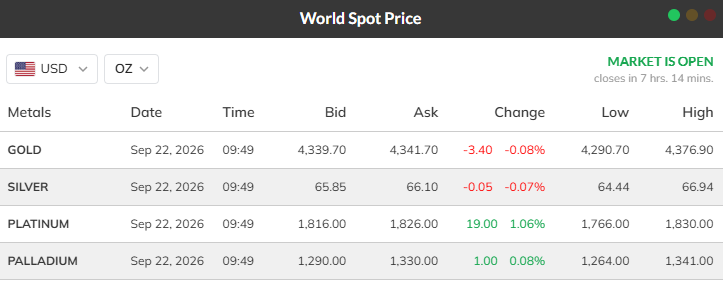
Spot at time of writing: Gold $4,341.70 | Silver $66.10 | Platinum $1,826 | Palladium $1,330
I've only have two major wholesale sheets to work with this morning, so we're hesitant to call any individual quote a broad market trend. Still, the picture they paint is interesting. Gold premiums remain relatively stable, silver has actually firmed slightly in several categories, and 90% continues to hold the ground it regained this summer.
The more interesting story, however, is further down the sheets. We don't often spend much time on platinum and palladium, but today's markets provide an unusually good illustration of something we're seeing across the physical market: wholesalers are increasingly differentiating between metal they can easily resell and metal they may have to warehouse.
In other words, the market isn't simply paying for metal. It's paying for liquidity.
Gold and Silver: Flagship Products Continue to Matter
Gold remains fairly stable from a premium standpoint. Common-date 1 oz Gold Eagles are bringing roughly +0.50% to +0.55% on the wholesale bid, with asks around +1.50%. Gold Buffalos remain stronger at +1.25% to +1.65% bid, while common .9999 Maples are around +$5 to +$10.
Move away from those flagship products and the market changes quickly. Krugerrands are around -0.70% to -0.75%, Philharmonics are around -0.50% on one sheet, Mexican 50 Pesos are roughly -0.75%, and many traditional world-gold products are trading at even larger discounts.
Silver actually looks a little healthier this week. Generic rounds are around -$1.70 to -$1.75, while common 10 oz bars are approximately -$1.65 to -$1.75. That's still cheap physical silver, but it's a substantial improvement from the -$5 and even -$7 bids we saw during the weakest portions of the summer. Silver Eagles continue to command a meaningful premium, with sealed boxes around +$1.75 bid and asks roughly +$2.65 to +$2.75.
90% silver is also remarkably steady. Wholesale bids remain around -$3.75 to -$4.00, essentially the same range we've seen for several weeks. Considering that bags deteriorated toward -$10 earlier this summer, simply holding this recovered level is encouraging.
Platinum: The Packaging Matters
Platinum is where today's sheets become especially interesting. One wholesaler is paying +$50 for a Platinum Eagle, +$25 to +$28 for carded 1 oz bars, +$40 for Britannias and +$30 for year-varies Maples. That's a reasonably healthy physical market at roughly $1,826 platinum.
The other wholesaler is much more discriminating. They'll pay +$55 for a Platinum Eagle, +$25 for a Maple, +$25 for a Britannia and +$25 for a carded 1 oz bar. Take that same ounce out of the card, however, and the bid falls to -$30. Move to a generic 10 oz platinum bar and the bid drops to -$40. Miscellaneous world platinum is -$5.
That's a remarkable spread for products containing essentially the same metal. A carded one-ounce bar versus an uncarded one-ounce bar represents a $55 difference in wholesale bid on the same sheet.
That doesn't necessarily tell us the wholesaler is bearish on platinum. It tells us they're much more comfortable owning platinum with an obvious retail exit.
Palladium Makes the Point Even Clearer
Palladium takes that distinction to another level. One wholesaler is bidding ordinary 1 oz palladium bars and coins at -$25, with a +$35 ask. The other will pay spot for a carded Valcambi bar.
But move into recognizable sovereign products and the premiums become enormous. That same wholesaler is paying +$50 for a Canadian Palladium Maple and an extraordinary +$375 for an American Palladium Eagle, with asks of +$175 and +$450 respectively.
At approximately $1,330 palladium, that's not really a bet on the underlying metal anymore. It's a market for the product itself. The ordinary palladium ounce is worth roughly melt; the scarce, recognizable and readily marketable form can be worth hundreds more.
And that's really the same phenomenon we're seeing throughout today's sheets. A Gold Eagle brings a premium while a Krugerrand trades below spot. A Silver Eagle brings nearly $2 over while a generic round trades nearly $2 under. A carded platinum ounce can bring $55 more than an uncarded ounce. An American Palladium Eagle can command hundreds of dollars more than an ordinary palladium bar.
The metal hasn't changed. The exit strategy has.
UnderSpot Take
The physical market isn't particularly dramatic this week, but the pricing structure is telling us quite a bit about what wholesalers currently value.
Gold Eagles, Buffalos and Maples remain healthy. Silver has improved modestly, while 90% appears increasingly comfortable around its -$4 floor. Platinum and palladium, however, expose the underlying theme particularly well: wholesalers are willing to pay for products they know they can move, while becoming considerably more defensive when the same metal comes in a form they may have to warehouse.
In a volatile market, that makes sense. A Gold Eagle or Silver Eagle can usually be laid off quickly. A recognizable platinum sovereign has an established retail market. A generic 10 oz platinum bar is a different proposition entirely.
So this week, the premium isn't necessarily about scarcity. It isn't even entirely about demand for the underlying metal.
It's about liquidity.
And right now, the easiest ounce to sell is increasingly the most valuable ounce to own.