UnderSpot Report; September 28, 2026


The Price of Metal Is Falling Faster Than the Price of Owning It
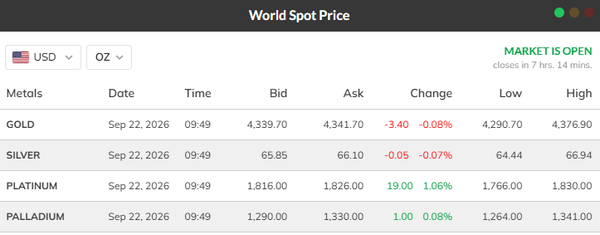
Spot at time of writing: Gold $4,139.90 | Silver $61.47 | Platinum $1,734
Metals are taking a beating today.
Gold is down roughly $146, or 3.4%, while silver has fallen nearly $3, or 4.6%. Platinum and palladium are participating in the selloff as well, down 2.7% and 4.6%, respectively.
Normally, a move of this magnitude would lead us to expect physical premiums to retreat alongside spot. If the decline reflected broad weakness in physical demand, wholesalers would have little incentive to stretch for inventory.
That's not what we're seeing.
Premiums aren't exploding, but they're proving surprisingly resilient. In several flagship products they're moving higher. At the same time, our own retail activity has been strong in both directions.
Something unusual is happening underneath the spot price.
Gold: Spot Falls, Flagship Premiums Hold
Gold Eagles remain one of our favorite bellwethers, and they're refusing to follow gold lower.
Two wholesalers are around +0.50% to +0.55% on the bid and +1.50% on the ask for common-date 1 oz Eagles. Even the more defensive market, which is bidding only 99.65% of spot, is asking +1.10% and showing a 3–5 day delay.
Fractional Eagles are stronger still, with quarter-ounce coins bringing roughly +3.00% to +3.25% and 1/10 oz coins reaching +5.50% to +6.00% on the wholesale bid.
Gold Buffalos are arguably more interesting. Year-varies coins show bids as high as +1.50% to +1.85%, with asks approaching +3%. Even the more defensive wholesaler remains above spot on the bid.
That's a notable divergence. Gold has lost nearly $150 today, yet some of the most liquid physical products are commanding stronger, not weaker premiums.
Silver: A Nearly 5% Decline, but Premiums Don't Follow
Silver tells much the same story.
At roughly $61.47, silver is down about 4.6% today. Yet conventional wholesale bids for generic rounds remain around -$1.70 to -$1.75, while common 10 oz bars are approximately -$1.65 to -$1.75.
Those aren't strong premiums, but importantly, they haven't deteriorated alongside today's enormous move in spot.
90% silver remains surprisingly resilient as well. Mainstream wholesale bids are still around -$3.65 to -$3.75, continuing to hold the substantial recovery we've watched from discounts approaching -$10 earlier this summer.
Silver Eagles continue to separate themselves from generic metal. Sealed boxes remain around +$1.70 to +$1.75 on the bid, with asks roughly +$2.60 to +$2.75.
Again, the screen is falling much faster than the physical market.
From the Counter
Our own activity adds an important piece of on-the-ground data.
Last week, we sold $$125,000 in gold in our physical storefront…but that was only one side of the counter.
During the same week, we also purchased approximately $60,000 in gold over the counter from customers.
That means we're seeing substantial physical activity in both directions. Some holders are using these historically high nominal prices as an opportunity to sell, while other buyers are continuing to accumulate metal despite or perhaps because of the volatility.
One retail operation certainly doesn't define the national physical market. But this is precisely the kind of information we want UnderSpot to capture. Wholesale sheets tell us what dealers are willing to pay. Activity across an actual retail counter tells us whether metal is moving.
Right now, it is.
So Why Are Premiums Firming?
We generally avoid trying to explain why spot moves. There are enough people attempting to predict gold and silver prices already, and UnderSpot has always been more interested in observing the physical market than forecasting the paper one.
But today's divergence deserves some examination.
One possibility is straightforward: buyers are stepping into the decline. A customer who hesitated at $4,500 or $4,600 gold may view $4,100 differently. If retail inventory begins moving quickly as spot falls, dealers and wholesalers have to replace that inventory, supporting premiums even as the underlying metal declines.
Replacement risk may matter too. We've spent much of this year watching gold make enormous moves only to reverse shortly afterward. A wholesaler selling aggressively into today's decline risks having to replace that inventory into a sharp rebound tomorrow. Maintaining an adequate spread becomes particularly important when $50–$100 daily moves no longer feel exceptional.
Availability adds another wrinkle. One of the more defensive wholesale markets is showing 3–5 day delays on 1 oz Gold Eagles, two weeks on quarter-ounce Eagles, two weeks on Gold Maples and four weeks on Silver Maples.
Interestingly, that same market is extremely defensive on several generic products. That suggests the issue isn't simply a shortage of metal. Wholesalers appear increasingly selective about what inventory they're willing to own and at what price.
The Divergence Is the Story
We can't prove from wholesale pricing alone why the physical market is behaving this way.
What we can observe is the divergence.
Gold is down more than 3%. Silver is down nearly 5%. Yet Gold Eagle premiums are holding. Buffalos are strengthening. Fractional gold remains expensive. Silver Eagle premiums remain intact. 90% isn't giving back its recent recovery. And some major bullion products continue to show meaningful delivery delays.
Meanwhile, our own counter moved more than $125,000 of gold out last week while simultaneously taking in roughly $60,000 of gold from the public.
That's not a market frozen by uncertainty.
It's a market actively repricing metal between buyers and sellers.
UnderSpot Take
Today's screen is ugly. There's no getting around a $146 decline in gold or a nearly $3 decline in silver.
But UnderSpot exists precisely because the spot price doesn't tell us everything about the physical bullion market.
Today is an unusually good example.
If physical demand were collapsing alongside spot, we would expect premiums to weaken materially. Instead, the opposite is happening in several important categories. Buyers appear willing to absorb metal at lower prices, flagship products are retaining their premiums, and wholesalers remain selective about the inventory they're willing to own.
We won't pretend to know whether gold is going to $4,000 or back to $4,500 from here.
We don't need to.
The observable physical-market story is interesting enough:
The price of the metal is falling faster than the price of owning the metal.
And on a day like today, that may tell us more about the physical market than the red numbers on the screen.